Ποιος χρονολόγησε Βολουμνία Κυθηρίς;
Γάιος Κορνέλιος Γάλλος dated Βολουμνία Κυθηρίς from ? until ?.
Marcus Junius Brutus dated Βολουμνία Κυθηρίς from ? until ?.
Mark Antony dated Βολουμνία Κυθηρίς from ? until ?.
Βολουμνία Κυθηρίς

Volumnia Cytheris (fl. 1st-century BC) was an ancient Roman actress and mimae dancer. She is foremost known as the mistress of several famous Romans.
Possibly born around 70 B.C., she was originally a slave of Publius Volumnius Eutrapelius but later became a freedwoman. On stage, she was normally referred to only as Cytheris. The name derived from "Cythera" a nickname for Aphrodite. She had relationships with Brutus and Mark Antony, which attracted a lot of attention in contemporary ancient Rome. She is mentioned as the companion of her aristocratic lovers in social occasions when the presence of a courtesan was otherwise not common, and considered shocking.
Cicero's letters recount how embarrassed he was to go to a party that she also attended, and how offensive it was for Mark Antony to give her a place of dignity in his litter:
"The tribune of the people was borne along in a chariot, lictors crowned with laurel preceded him; among whom, on an open litter, was carried an actress; whom honourable men, citizens of the different municipalities, coming out from their towns under compulsion to meet him, saluted not by the name by which she was well known on the stage, but by that of Volumnia. A car followed full of pimps; then a lot of debauched companions; and then his mother, utterly neglected, followed the mistress of her profligate son, as if she had been her daughter-in-law. O the disastrous fecundity of that miserable woman! With the marks of such wickedness as this did that fellow stamp every municipality, and prefecture, and colony, and, in short, the whole of Italy."
Later, Cicero's wife asked Cytheris to help mend the relationship between her husband and Cytheris' lover Mark Antony, so that he could return from exile in Brundisium.
Her rejection of Cornelius Gallus reportedly provided the theme for Virgil's tenth Eclogue. Gallus refers to her in his work under the name Lycoris, which alludes to one of the names "Lycoreus" the god Apollo, Greek god of music.
She is one of few free influential Roman courtesans mentioned by her contemporaries, others being Praecia and Chelidon. Cytheris' fate is unknown and she is not mentioned in any sources after a certain point.
Διαβάστε περισσότερα...Γάιος Κορνέλιος Γάλλος

Gaius Cornelius Gallus (c. 70 – 26 BC) was a Roman poet, orator, politician and military commander, at one time appointed by the Emperor Augustus as prefect of Roman Egypt. Only nine lines of his poetry are extant today, but he was much read in antiquity; Ovid considered him one of the major Latin poets of his age.
Διαβάστε περισσότερα...Βολουμνία Κυθηρίς
Marcus Junius Brutus

Marcus Junius Brutus (; Latin: [ˈmaːrkʊs juːniʊs ˈbruːtʊs]; c. 85 BC – 23 October 42 BC) was a Roman politician, orator, and the most famous of the assassins of Julius Caesar. After being adopted by a relative, he used the name Quintus Servilius Caepio Brutus, which was retained as his legal name. He is often referred to simply as Brutus.
Early in his political career, Brutus opposed Pompey, who was responsible for Brutus' father's death. He also was close to Caesar. However, Caesar's attempts to evade accountability in the law courts put him at greater odds with his opponents in the Roman elite and the senate. Brutus eventually came to oppose Caesar and sided with Pompey against Caesar's forces during the ensuing civil war (49–45 BC). Pompey was defeated at the Battle of Pharsalus in 48, after which Brutus surrendered to Caesar, who granted him amnesty.
With Caesar's increasingly monarchical and autocratic behaviour after the civil war, several senators who later called themselves liberatores (liberators) plotted to assassinate him. Brutus took a leading role in the assassination, which was carried out successfully on the Ides of March (15 March) of 44 BC. In a settlement between the liberatores and the Caesarians, an amnesty was granted to the assassins while Caesar's acts were upheld for two years.
Popular unrest forced Brutus and his brother-in-law, fellow assassin Gaius Cassius Longinus, to leave Rome in April 44. After a complex political realignment, Octavian – Caesar's adopted son – made himself consul and, with his colleague, passed a law retroactively making Brutus and the other conspirators murderers. This led to a second civil war, in which Mark Antony and Octavian fought the liberatores led by Brutus and Cassius. The Caesarians decisively defeated the outnumbered armies of Brutus and Cassius at the two battles at Philippi in October 42. After the defeat, Brutus took his own life.
His name has become a synonym and byword for "betrayal" or "traitor" in most languages of Europe. His condemnation for betrayal of Caesar, his friend and benefactor, is perhaps rivalled only by the name of Judas Iscariot, with whom he is portrayed in Dante Alighieri's Inferno. He also has been praised in various narratives, both ancient and modern, as a virtuous and committed republican who fought – however futilely – for freedom and against tyranny.
Διαβάστε περισσότερα...Βολουμνία Κυθηρίς
Mark Antony
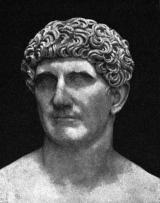
Ο Μάρκος Αντώνιος (Marcus Antoniusα[›], 14 Ιανουαρίου 83 π.Χ. - 1 Αυγούστου 30 π.Χ.) ήταν Ρωμαίος πολιτικός και στρατηγός, ο οποίος διαδραμάτισε σημαντικό ρόλο κατά τη μετατροπή της Ρωμαϊκής Δημοκρατίας στη Ρωμαϊκή Αυτοκρατορία.
Ο Μάρκος Αντώνιος ήταν υποστηρικτής του Ιούλιου Καίσαρα και υπηρέτησε ως ένας από τους στρατηγούς του κατά την κατάκτηση της Γαλατίας και κατά τον εμφύλιο πόλεμο. Διορίστηκε διοικητής της Ιταλίας ενώ ο Καίσαρας εξάλειψε τους πολιτικούς αντιπάλους του στην Ελλάδα, τη Βόρεια Αφρική και την Ισπανία. Με τη βοήθεια του Ιούλιου Καίσαρα, ο Μάρκος Αντώνιος έγινε ταμίας, δήμαρχος, ίππαρχος και έπειτα ύπατος, περίπου το 44 π.Χ..
Το 43 π.Χ. δημιούργησε τριανδρία, μαζί με τον Οκταβιανό και τον Λέπιδο, με σκοπό να τιμωρήσουν ενωμένοι τους δολοφόνους του Ιούλιου Καίσαρα. Αμέσως οι τρεις άντρες διέταξαν τις "προγραφές", κατά τις οποίες εκατοντάδες Ρωμαίοι πολίτες, αντίθετοι με το καθεστώς, γράφτηκαν σε καταλόγους, συνελήφθησαν και θανατώθηκαν. Μεταξύ αυτών ήταν και ο Κικέρωνας, σφοδρός πολέμιος του Μάρκου Αντώνιου.
Το 42 π.Χ. ο Αντώνιος, μαζί με τον Οκταβιανό, νίκησε στους Φιλίππους της Μακεδονίας τους δολοφόνους του Καίσαρα, τον Βρούτο και τον Κάσσιο. Μετά τη νίκη τους, τα τρία μέλη της Τριανδρίας μοιράστηκαν τις κτήσεις του ρωμαϊκού κράτους. Ο Αντώνιος έλαβε υπό τον έλεγχό του την Ανατολή.
Κατά την περίοδο που ετοίμαζε την εκστρατεία του εναντίον των Παρθών, ο Μάρκος Αντώνιος γνώρισε την Κλεοπάτρα, την οποία είχε αρχικά αποφασίσει να τιμωρήσει επειδή είχε συνταχθεί με το πλευρό του Βρούτου και του Κάσσιου. Ωστόσο, γοητευμένος από τη βασίλισσα της Αιγύπτου, αποφάσισε να γίνει εραστής της. Η επιρροή της πάνω του ήταν τόση που σύντομα προκάλεσε την αντίδραση των πολιτών της Ρώμης. Εξαιτίας της, ο Αντώνιος ήλθε σε ρήξη με τη Σύγκλητο και τον ίδιο τον Οκταβιανό.
Όταν ο Μάρκος Αντώνιος προσέφερε ως δώρο στην Κλεοπάτρα εκτεταμένα εδάφη της Ασίας και ζήτησε διαζύγιο από τη νόμιμη σύζυγό του Οκταβία τη Νεότερη, αδελφή του Οκταβιανού, η Σύγκλητος και ο ρωμαϊκός λαός εξοργίστηκαν. Ο Οκταβιανός κήρυξε εναντίον του πόλεμο, ο οποίος κρίθηκε στο ακρωτήριο Άκτιο, στην είσοδο του Αμβρακικού κόλπου.
Ο Αντώνιος, νικημένος, επέστρεψε στην Αίγυπτο, όπου τον ακολούθησε ο νικητής Οκταβιανός. Βλέποντας τους άντρες του να στρέφονται τελικά με το μέρος του Οκταβιανού και να επιτίθενται στην Αλεξάνδρεια, ο Αντώνιος αποφάσισε να αυτοκτονήσει. Παρόμοια ήταν η κατάληξη και της τελευταίας συζύγου του, Κλεοπάτρας, με τον θάνατο της οποίας η Αίγυπτος έγινε τελικά επαρχία του ρωμαϊκού κράτους.
Η ζωή του Μάρκου Αντώνιου ήταν ταραχώδης και αυτό οδήγησε τον Πλούταρχο στην παράλληλη βιογράφησή του με τον Δημήτριο τον Πολιορκητή, καθώς και οι δύο, αν και σπουδαίοι στρατηγοί και πολιτικοί, καταστράφηκαν εξαιτίας του χαρακτήρα τους.
Διαβάστε περισσότερα...