Ποιος χρονολόγησε Constantine IX Monomachos;
Constantine IX Monomachos
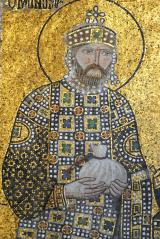
Constantine IX Monomachos (Greek: Κωνσταντῖνος Μονομάχος, romanized: Kōnstantīnos Monomachos; c. 980/c. 1000 – 11 January 1055) reigned as Byzantine emperor from June 1042 to January 1055. A member of the urban aristocracy, Constantine became emperor through marriage to the ruling empress Zoë Porphyrogenita in 1042. The couple shared the throne with Zoë's sister Theodora Porphyrogenita. Constantine's energetic rule was one of the most consequential in the Byzantine Empire's tumultuous 11th century.
Fiscally, Constantine's reign was marked by prodigality, and he depleted the abundant imperial treasury he had inherited from Basil II (r. 976–1025) and his successors. For reasons that remain obscure Constantine debased the gold currency of the empire, the first permanent debasement of the coinage since its introduction by Constantine the Great. In Constantinople Constantine spent lavishly on both personal gifts and religious projects. Presiding over a period of economic expansion, Constantine encumbered the state by his massive expansion of the aristocracy.
In matters of provincial administration, Constantine attempted a series of reforms to varying levels of success. In the power struggle between the urban elite and the Dynatoi which was waged throughout the 11th century, Constantine made overtures towards both. He granted tax exemptions to the Dynatoi through an early form of the pronoia system and freely granted titles, privileges, and gifts of money to the civil elite. In response to the rising importance of civil judges (known as kritai) over theme commanders (strategoi) Constantine created the office of the Epi ton kriseon. Constantine attempted to reform the empire's legal system, centering on the creation of a law school headed by a nomophylax, but had limited success.
Constantine was victorious in two civil wars, foiled several coup attempts and successfully fought off a raid by the Kievan Rus', but was humiliated by the Pechenegs in the West and failed to stop the rising Seljuq Turks in the East. Though the Byzantine Empire largely retained the borders established after the conquests of Basil II — even expanding eastwards through the annexation of the Armenian kingdom of Ani — Constantine is often blamed for the poor state of the army in the years leading up to Manzikert.
In 1054 Constantine oversaw the decisive events of the Great Schism between the Catholic and Eastern Orthodox Churches. His treatment of the papal legates of Leo IX exacerbated tensions between the legates and the patriarch Michael I Cerularius of Constantinople. He died one year later of an infection related to his chronic arthritis.
Traditionally, Constantine Monomachos has been viewed as an incapable, militarily inept emperor and one of the architects of the Byzantine decline of the late 11th and 12th centuries. However, recent scholarship has done much to rehabilitate his reputation as a civil administrator and reformer. He was perhaps the only emperor between Basil II and the Battle of Manzikert to attempt a coherent program of reform, even if this program was flawed and unsuccessfully carried out. Constantine accordingly may be considered the last effective emperor of the Macedonian Renaissance.
Διαβάστε περισσότερα...Maria Skleraina
Η Μαρία Σκλήραινα (απεβ. το 1045), που συχνά αναφέρεται μόνο ως Σκλήραινα, ήταν η πολιτική σύμβουλος, η επίσημη ερωμένη και η σύζυγος του Αυτοκράτορα των Ρωμαίων Κωνσταντίνου Θ΄ Μονομάχου, με τον (αμφιλεγόμενο) τίτλο της σεβαστής.
Διαβάστε περισσότερα...